
The educational activities of the Department of Hygiene and Social Medicine constitute one of its priority areas. The Department provides training for higher education students in 17 compulsory and 18 elective disciplines within educational programmes, including courses delivered in English. The total volume of teaching workload in the 2025/2026 academic year amounts to 4,279 academic hours, of which 349 hours are allocated to lectures and 3,865 hours to practical, laboratory, and seminar classes.
Teaching at the Department is conducted in accordance with the recommendations of standard curricula approved by the Ministry of Health and the Ministry of Education and Science of Ukraine and further refined by the academic staff of the Department within the established regulatory framework. All disciplines are taught in compliance with the guidelines and regulations of the Bologna Process.
The educational process at the Department is implemented using modern multimedia and computer technologies, a sufficient range of visual teaching aids, and active encouragement of higher education students to engage in the Department’s clinical and research activities. Innovative approaches to education are widely applied, including online consultations, joint discussions with students via voice and test-based chats, and remote assessment of readiness for the KROK licensing examination, among others.
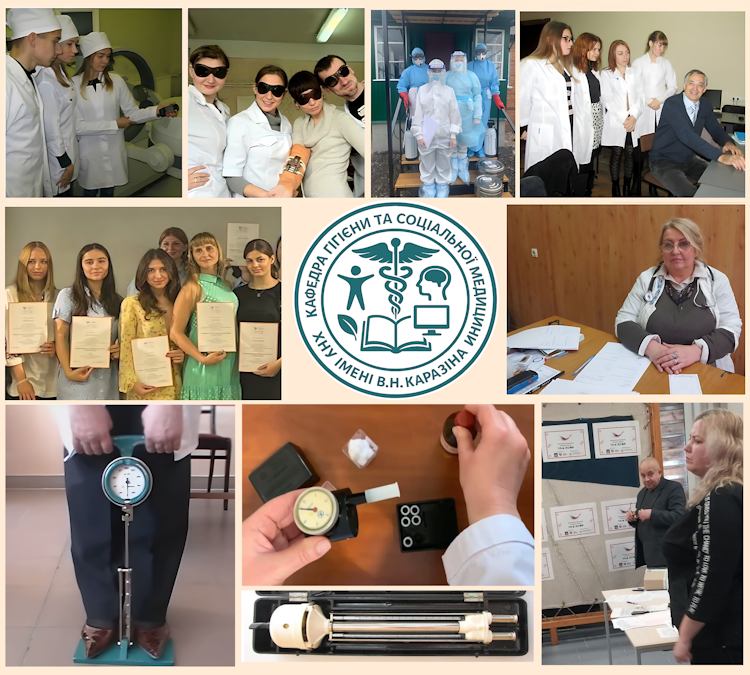
In the course of their studies, higher education students have the opportunity to familiarize themselves with the operation of modern equipment used to assess population health and environmental quality, which is available at the Department.
Practical classes are conducted with extensive use of standardized tasks. Together with academic staff, higher education students participate in hygienic investigations, followed by the preparation of sanitary inspection reports for hospital ward units, healthcare facility catering units, educational classrooms and laboratories in general secondary education institutions, residential units in dormitories, as well as the collection of drinking water samples for bacteriological and chemical analysis. Students are also involved in assessing physical development and nutritional status of children and adolescents, implementing health promotion activities among schoolchildren, and organizing round-table discussions and lectures for parents of school students. Thus, already during their studies, higher education students acquire invaluable experience in the field of preventive medicine.
Particular emphasis in the educational process is placed on preparing higher education students for the KROK 2 licensing examination. This preparation includes systematic analysis of test items from all available databases and test banks in Hygiene and Social Medicine; the use of software specifically developed for the Medical Faculty; computer classrooms and multimedia equipment; Internet-based systems for distance learning and knowledge assessment; as well as face-to-face and online consultations provided by academic staff on KROK-related issues throughout the entire period of studying the discipline, with an evenly distributed test workload for students. The effectiveness of student preparation for the KROK examination in the Department’s disciplines is confirmed by examination results, according to which the Medical Faculty annually occupies leading positions in national rankings among medical higher education institutions in Ukraine.
During the educational process, academic staff of the Department identify and prepare the most talented higher education students for participation in All-Ukrainian Olympiads, competitions, conferences, congresses, and other academic events in the relevant disciplines. In the course of these activities, students of the Medical Faculty have repeatedly won prize places and have been recognized with diplomas, letters of appreciation, certificates, awards, and other distinctions.

-
-
-
-
Факультет у соціальних мережах: